

What most multichannel sellers are actually dealing with
One tool for inventory. Another for orders. A third for repricing. A spreadsheet for pricing rules. And a separate seller dashboard for every marketplace you’re on.
Most sellers didn’t plan it this way. It happened gradually: each problem got solved with whatever tool was available at the time. The result? A patchwork of disconnected systems, inconsistent data, and no clear answer for when something goes wrong.
It costs time. It ties up staff. And it multiplies the risk of errors at every handoff.
Warning signs your tool stack isn’t keeping up
Most sellers don’t realize the setup is the problem. They chalk it up to a one-off glitch, a bad sync, a human error. But when the same issues keep coming back, that’s not a coincidence.
Listings rejected by marketplaces.
Every channel has its own attribute requirements, its own content specs, its own validation rules. What flies on Amazon gets flagged on Cdiscount for a missing field. What’s correct on Fnac doesn’t meet ManoMano’s format. When your catalog tool isn’t built for these differences, rejections pile up. Products that never go live, sales you never knew you missed.
Inventory out of sync across channels.
An item sells on Amazon. Your other channels don’t know yet. Another order comes in on Cdiscount for the same SKU. Oversell. Forced cancellation. Penalty. This isn’t a staffing issue. It’s a latency issue between systems that weren’t designed to talk to each other in real time.
Orders processed late.
When every marketplace has its own back office, you’re constantly switching tabs to check for new orders. In peak periods (Black Friday, sales season), something always slips through. Miss a dispatch window and you’re looking at a defect rate hit, a warning, or worse.
Prices that aren’t competitive.
Your competitors are repricing around the clock. You’re updating prices when you have bandwidth. The Buy Box goes elsewhere. Sales slow down and it’s not immediately obvious why.
Time wasted connecting the dots.
Switching between dashboards, cross-checking figures manually, making sure what happened in one tool is reflected in another. That’s not operations, that’s maintenance.
What a proper multichannel tool actually covers
A marketplace feed manager worth using should handle four things. Not as separate modules stitched together, but as one system, on one dataset.
Listing distribution across all your channels
Every marketplace has its own data requirements. Titles, categories, attributes, image specs: all different, all mandatory, all enforced at the point of submission. If your tool can’t adapt your catalog per channel automatically, someone on your team is doing that manually.
WeTransform, integrated into Sellermania, handles that transformation for you. Your product data gets reformatted to match each channel’s specs before it’s submitted. Clean listings, no rejections, no extra work on your end.
Centralized order management
Juggling four or five seller dashboards to process orders is a recipe for delays and missed SLAs. Sellermania pulls every order into a single interface, regardless of where it came from, within minutes. From there you can process in bulk, auto-send invoices, handle VAT on margin for refurbished goods, and manage IMEI and serial numbers. Everything that normally takes multiple steps across multiple back offices, done in one place.
Real-time inventory sync
This is where most multichannel setups fall apart. When a sale happens, how fast do your other channels update?
Most tools pull inventory data from your CMS or ERP on a cycle. That cycle typically runs every two to four hours. In two hours on an active catalog, you can easily take in dozens of orders across channels. The oversells follow.
Sellermania keeps a local copy of your inventory, updated continuously. Channel sync happens in under five minutes. Those two to four hours are precisely the window where oversells, cancellations, and penalties happen. Fast sync isn’t a nice-to-have. It’s what protects your seller account health.
Automated repricing by channel
Set it too high and you lose the Buy Box. Set it too low and you erode your margins. Manually updating prices across four or five channels at scale isn’t sustainable.
WeReprice is the only dynamic repricing engine built natively into a marketplace feed manager. Not a third-party tool bolted on behind the scenes, but a fully integrated module running on the same live inventory data as the rest of the platform. You set the rules: which products, which channels, which competitors to track, floor and ceiling prices. WeReprice monitors your competition continuously and adjusts your prices accordingly, without ever going below your minimum to protect your margins. The numbers speak for themselves: +300% in sales on Fnac, +132% on Cdiscount, +90% on Amazon for sellers using the repricing engine.
Avant / Après : ce que change Sellermania
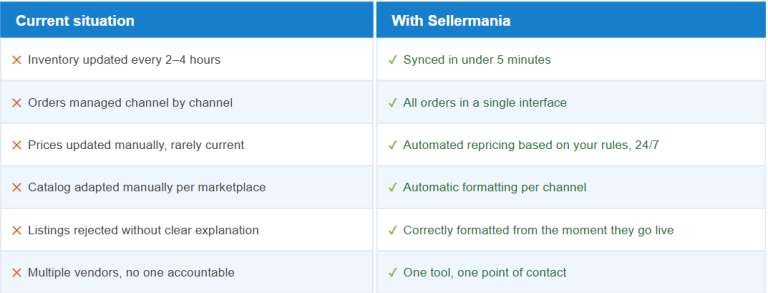
Selling on multiple marketplaces doesn’t have to mean running multiple operations. Complexity is a choice, specifically the choice of tooling.
Sellermania is the marketplace feed manager that centralizes everything in one interface. Catalog, inventory, orders, repricing. Add channels without adding overhead.
Demonstration
Discover how Sellermania will transform the way you work
- Free demo, no strings attached